
I should start with a confession: as a boy I hated PE, and I had no interest in football at all. It took my best friend Jared, a lifelong Manchester United fan, to finally show me the error of my ways. His timing was perfect, because the Premier League had just begun and United were about to enter some glorious years.
The player who really won me over was Eric Cantona. I used to watch him when he didn’t have the ball: where he drifted, the space he found, how he seemed to see a pass before anyone else knew it was on. Once you start noticing that, you see how clever the game is, and I was hooked. I’ve watched every game since.
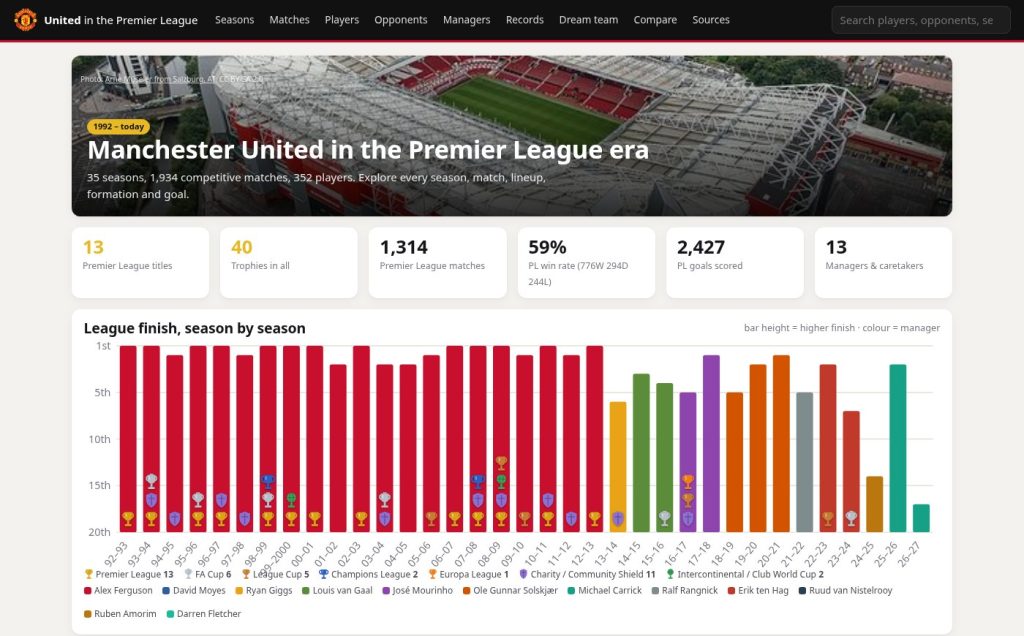
United’s Premier League story is one of the most documented in football, but it’s scattered: results in one place, line-ups in another, goals and kits and photos somewhere else again. I wanted one place where I could wander from a season to a match, from a match to a player, and from a player back to every goal he scored. So I built United in the Premier League, an explorer covering every season from 1992–93 to today.
What’s in it
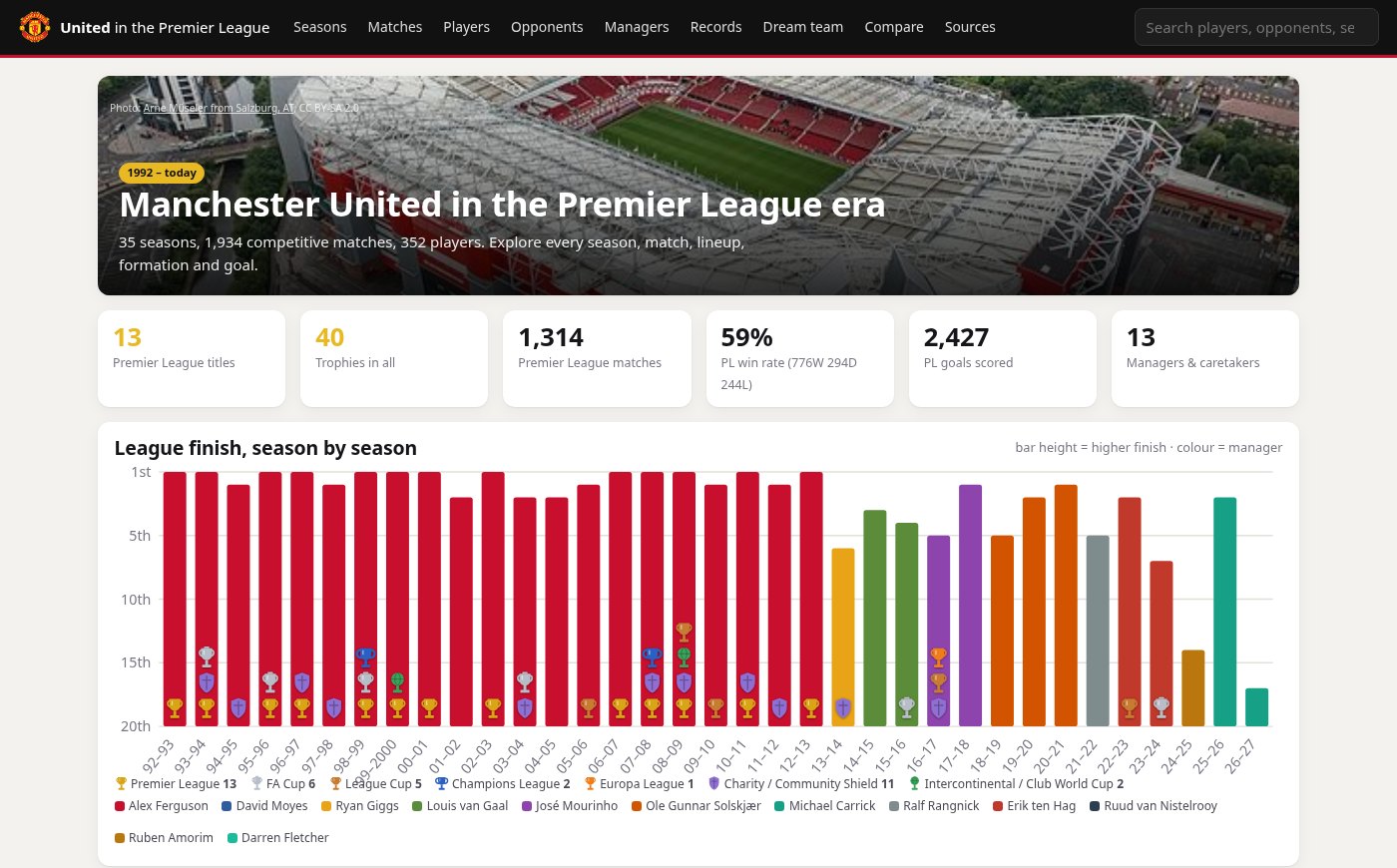
The site covers 35 seasons, nearly 2,000 competitive matches and more than 350 players. You can browse by season, match, player, opponent or manager, or just search.
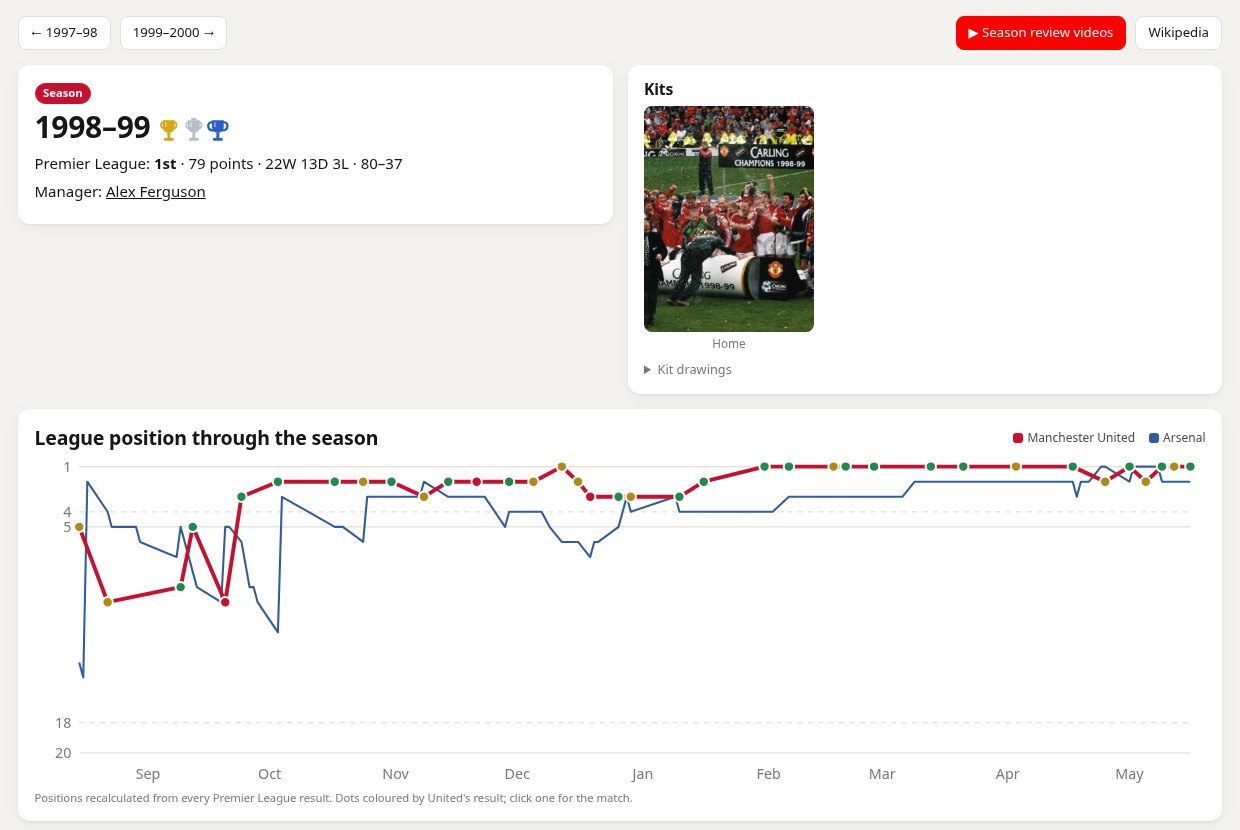
- Seasons: the final table position and record, the kits, and a chart of where United sat in the league after every round, rebuilt from every Premier League result that season.
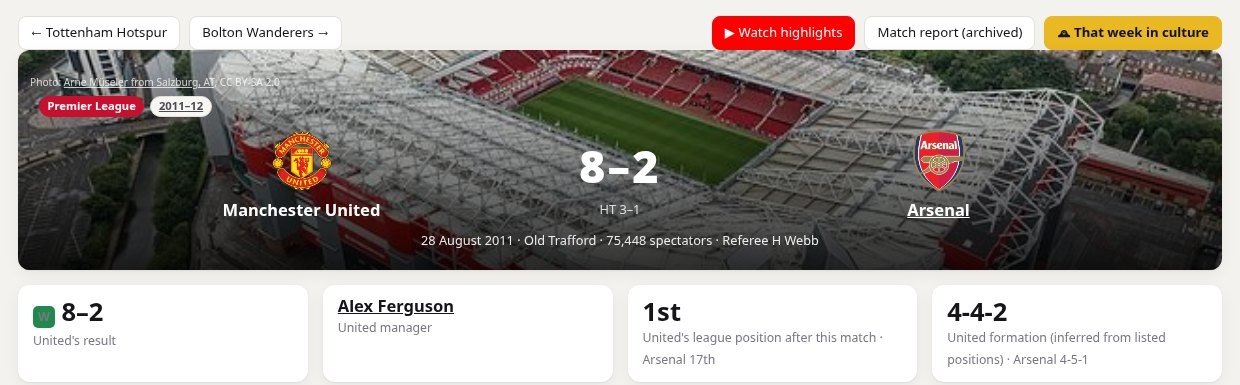
- Matches: score, scorers and minutes, line-ups and formations, a timeline of goals, cards and substitutions, match stats, highlights videos, and an archived match report where one exists.
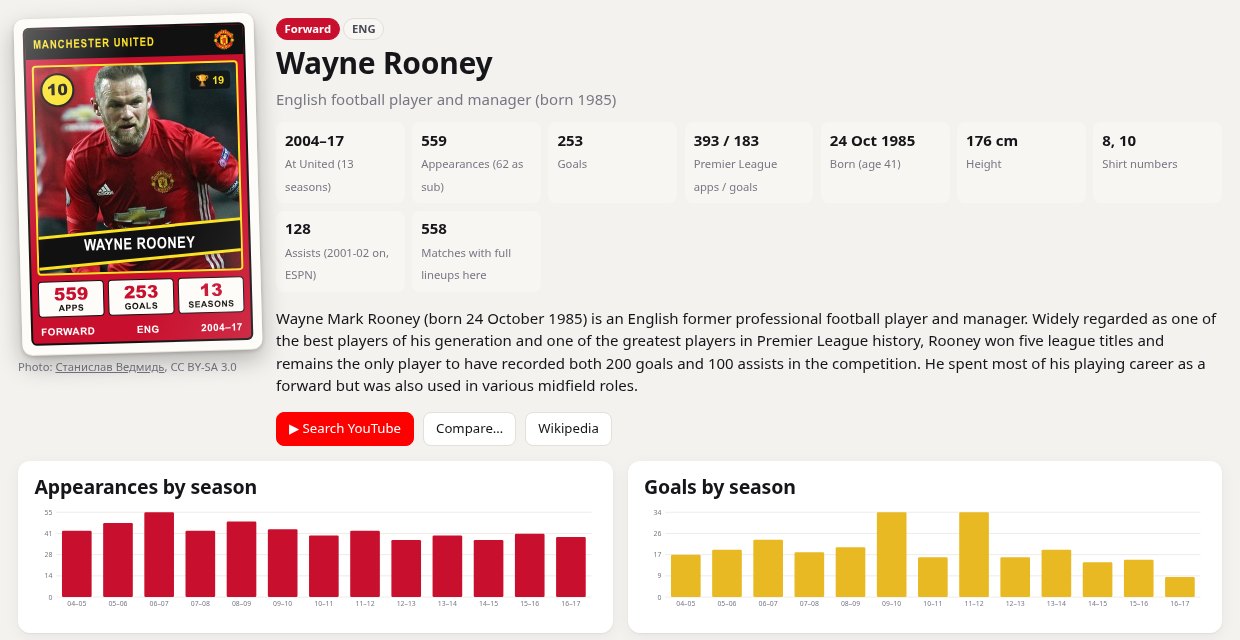
- Players: a trading-card style profile with appearances and goals by season, when in a match the goals came, and goals by competition.
- Extras: records, a dream team builder (pick your best XI from everyone since 1992 and share the link), a side-by-side compare tool, and my favourite, That week in culture, which shows the number one single and what everyday things cost in the week of any match.
Stitching the data together
No single free source has everything, so the site is built from several open ones, each covering a different stretch of history. Wikipedia’s season articles give every match and scorer back to 1992. Football-Data.co.uk has every Premier League result, which lets the site rebuild the full league table after each round. ESPN’s public data adds line-ups, events and commentary from 2001 onwards. Player and stadium photos come from Wikimedia Commons under free licences, with the photographer credited on every one.
Where the data is thinner, the site says so rather than guessing. Formations before about 2008, for example, are worked out from the positions players were listed in, and they’re labelled as “inferred”. That felt important: it’s a fan site, but the numbers should still be trustworthy.
How it came together
I built this with an AI coding assistant, and the work split neatly in two. First came a set of Python scripts that fetch the data, tidy it and join it up, so that “Rooney” in one source and “Wayne Rooney” in another become the same player. Then came the website itself, which is just plain HTML, CSS and JavaScript reading the files those scripts produce. There’s no database and no server code, which keeps it fast and cheap to host.
Each round of work followed the same loop: add a feature, open the site, look at a few matches I remember well, and fix whatever looked wrong. Sources disagree more often than you’d think. One source listed some matches twice, with the wrong score on one copy, so the build now checks each match against the known result and keeps the one that agrees. Features grew from there: trophy icons, kit photos, shot maps for a handful of matches with open data, and the culture pop-up.
The site keeps itself current too. After each matchday one script fetches anything new and rebuilds only what changed, and another uploads only the changed files. That turned a 30-minute first upload into a quick weekly update.
It’s an unofficial fan project and isn’t affiliated with Manchester United. Have a look, and tell me in the comments which match you looked up first.